Advanced Rehabilitation Research Training (ARRT) Program
Welcome to ARRT!
Are you a researcher interested in applying for a postdoctoral ARRT Program Fellowship?
Explore this page for more information.

What is the ARRT Program?
- 3-year postdoctoral training program on employment for people with intellectual and developmental disabilities (IDD)
- Provides advanced, multidisciplinary training in IDD employment research
- Addresses the critical need for better representation and capacity in the IDD research workforce and field
The ARRT program is housed at the Institute for Community Inclusion (ICI) at UMass Boston and brings together ICI’s expertise from the School of Global Inclusion and Social Development (SGISD) at UMass Boston and the National Association of State Directors of Developmental Disabilities Services (NASDDDS). ARRT is funded by the National Institute on Disability, Independent Living, and Rehabilitation Research (NIDILRR).
Meet our 2026 Spring ARRT Fellows!
Please join us in welcoming our first cohort of ARRT Postdoctoral Fellows, Dr. Melanie Lopez and Dr. Ashley E. Lazarre. They officially began their 12-month fellowship on March 2.
ARRT fellows, mentors, and program administrators, left to right: Kaitlyn Siner-Cappas (SGISD academic program director ), Dr. Jean Winsor (ARRT program director), Dr. Heike Boeltzig-Brown (ARRT program director), Dr. Clare Papay (mentor), Dr. Melanie Lopez (fellow), Dr. Ashley E. Lazarre (fellow), Dr. Esther Kamau (mentor), and Dr. Tiffany Donaldson (Dean of SGISD).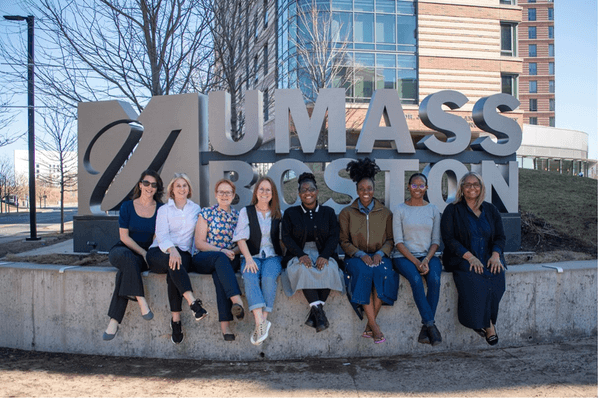
About Dr. Melanie Lopez
Dr. Lopez earned her PhD in Education from the University of Central Florida. She is also a proud alumna of Bethune-Cookman University, where she completed both her bachelor’s and master’s degrees in special education. Her research focuses on inclusive postsecondary education, transition outcomes, and predictors of earned wages from competitive integrated employment for individuals with intellectual and developmental disabilities. Her work emphasizes program evaluation, systems-level collaboration, and the translation of research into policy and practice.
Dr. Lopez brings experience across K–12 education, higher education instruction, and statewide program leadership. She currently serves as president of the Florida Council for Exceptional Children (FCEC), supporting statewide initiatives that advance outcomes for individuals with disabilities. In addition, she leads and contributes to community-based initiatives and provides mentorship and tutoring to aspiring special education practitioners.
She is passionate about designing inclusive pathways that prepare neurodivergent students for meaningful employment and independent lives. Through her research and teaching, she aims to advance sustainability efforts that extend beyond postsecondary opportunities and promote long-term workforce outcomes for individuals with disabilities.
About Dr. Ashley E. Lazarre
Dr. Lazarre is a Haitian American scholar, filmmaker, and digital content creator whose work explores the representation of Black women in digital spaces. She holds a PhD from UMass Boston’s School of Global Inclusion and Social Development, where her dissertation focused on digital media and storytelling. Her research examines stereotypes of Black women, embodied trauma, and holistic healing practices, with a focus on how Black women creators use platforms like Instagram to shape new narratives of identity and womanhood.
Her pedagogy centers visual storytelling as a site of knowledge production, by creating short films, documentaries, and social media content that foreground imagery, voice, and lived experience. Inspired by the 2010 Haiti earthquake in her personal life, she began her career in disability inclusion at Bay Cove Human Services, advocating for people with intellectual and developmental disabilities in workplace settings.
Beyond academia, Dr. Lazarre is known on social media for her digital activism and decolonizing beauty through Afrocentric braids and fashion.
Why ARRT?
We need better representation and capacity in the IDD research workforce and field! How do we know?
The workforce does not fully reflect or meet the needs of the populations it serves.
- People from a wide variety of communities and people with disabilities are underrepresented in the employment services workforce
- Qualified people from different backgrounds don’t enter or stay in the field because they lack role models
IDD research is not inclusive, and outcomes reflect that.
- There are differences in disability & IDD employment outcomes
- Current research interventions lack the broad range of perspectives, which limits the research effectiveness
These issues are exacerbated by systemic technological, architectural, and environmental barriers & weak institutional support.
Calling all Researchers! Do you want to join the ARRT?
Applications for the Fall 2026 fellowship positions are now closed.
We encourage individuals interested in future opportunities to reach out directly to the program contacts for more information.
Who are you?
- A U.S. citizen or legal permanent resident with a doctoral degree (or equivalent) in a relevant field, such as rehabilitation, education, social sciences, public health, or public policy
- Interested and experienced in disability research (especially IDD) with professional or volunteer experience in the field
- Committed to participating in all program activities and reporting requirements (30 hours/week)
Questions? Contact the Co-Program Directors:
- Dr. Heike Boeltzig-Brown, Sr. Research Associate and Sr. Manager of International Partnerships
- Dr. Jean Winsor, Sr. Associate & Director, IDD Employment Systems and Policy